Healthcare SEO Strategy 2026: Step-by-Step Guide with E-E-A-T, AEO, and AI Search Optimization
Healthcare buyers ask an AI assistant before they book. In July 2026, Semrush scored Delta Medical Labs at 18 on AI Visibility for Saudi diagnostics, against 14 for Al Borg and 14 for Wareed. That one comparative number is what this guide is about. Below is the step-by-step healthcare SEO and AI search playbook we run for labs, clinics, and hospital groups across Saudi Arabia, Egypt, and the Gulf. It covers what we measure, what we refuse to promise, and the points where the method stops working.
📌 Key Takeaways
- Healthcare SEO in 2026 requires E-E-A-T compliance + medical schema + AEO strategy
- AI Overviews sit on top of most YMYL health queries, so being cited inside the answer is the visibility
- Step-by-step: site architecture, content E-E-A-T signals, Schema markup, AEO FAQ layers
- Delta Medical Labs carries 5,570 pages cited by AI engines, 3,600 in AI Overviews and 1,800 in AI Mode, measured July 2026
What VOCTOS healthcare clients are cited for, and by how much
Source: published VOCTOS case studies and Semrush AI Visibility, July 2026. A page-level citation count says nothing about query share, and Semrush AI Visibility is a modelled index rather than a census. None of these engagements ran a holdout, so we do not claim the work isolates cause.
Why does healthcare SEO look different in 2026?
Healthcare is one of the most regulated, trust-sensitive categories on the web. Search engines and AI assistants apply Your Money or Your Life standards to every medical query, which means E-E-A-T is not optional. Add the new layer of generative AI, where ChatGPT, Gemini, and Google AI Overviews now answer patient questions directly, and the rules of healthcare SEO have changed.
You no longer compete only for blue links. You compete to be the cited authority inside the AI answer itself.
The 7 Pillars of Modern Healthcare SEO (2026)
The 7 Pillars of a Modern Healthcare SEO Strategy
Our engagements with hospitals, clinics, and laboratories across the region are built on a seven pillar framework, and the order matters as much as the list. Each pillar reinforces the others, so if you drop one of them, the rest carry less weight than the effort you put into them suggests.
1. E-E-A-T Foundations Built Into Every Page
Experience, Expertise, Authoritativeness, and Trust are the language Google and AI engines use to evaluate medical content. We embed real physician bylines with credentials, link to the source studies, expose review dates, and surface practitioner qualifications inside MedicalOrganization and Physician schema. Pages without verifiable expertise rarely earn citations in ChatGPT for clinical queries.
2. Patient Intent Mapping
Patient journeys are not linear. Somebody searching “RBC test meaning” can turn into a booking three days later for a CBC panel at the clinic across the street, which is why we map every priority condition, test, and procedure you offer against informational, navigational, comparative, and transactional intent. Each intent then gets its own page, tuned for the channel where your patient actually asks the question. Informational queries go to AI Overviews, comparative queries to ChatGPT and Perplexity, and transactional queries to Google Business Profile and local search.
3. Answer-First Content Architecture
AI engines lift the first 60 to 90 words of a well-structured answer. We rewrite every priority page so the first paragraph delivers the direct answer, followed by clinical depth, citations, and rich supporting media. This Answer Engine Optimization framework is the single largest lever for healthcare AI visibility.
4. Medical Schema Coverage
MedicalOrganization, MedicalClinic, Hospital, MedicalProcedure, Drug, MedicalCondition, Physician, and FAQPage schema together create a machine-readable knowledge graph that AI engines parse with confidence. Most healthcare websites we audit use a fraction of the available types. The VOCTOS technical team layers all relevant schema and validates it against Schema.org and Google Rich Results.
5. Local and Regional Authority
Patients book labs and clinics close to home. Google Business Profile, local citations, regional directories, and city-level landing pages are still the foundation of local healthcare SEO. We pair these with city-specific content like best laboratory in Riyadh, best women’s clinic in Cairo, or best hospital in Jeddah, each engineered to win both the local pack and the AI answer.
6. Trust and Reputation Engineering
Reviews, testimonials, accreditations, regulatory licenses, and press mentions are the signals AI engines use to validate that a healthcare brand is real and respected. We design a structured trust engine that surfaces these signals across the site, the schema, and authoritative third-party platforms.
7. Generative Engine Optimization for AI Visibility
Once the foundation is solid, we layer the Generative Engine Optimization framework. This is how we move a brand from invisible to cited inside ChatGPT, Gemini, and Google AI Overviews. It involves entity clarification, citation acceleration, and continuous AI feedback loops where we monitor exactly what ChatGPT and Perplexity say about the brand and refine content accordingly.
🗓 The VOCTOS Healthcare SEO Process: 6 Steps
The VOCTOS Step-by-Step Healthcare SEO Process
Step 1: AI Visibility and SEO Audit
We map current ChatGPT, Gemini, Perplexity, and Google AI Overviews citation share against 150 to 300 priority queries. We pair this with a full technical SEO audit, schema audit, and competitive gap analysis. The output is a single document that shows exactly where the brand stands and what it costs in lost bookings every month.
Step 2: Strategy and Roadmap
From the audit we build a 90 day plan with weekly milestones, content velocity targets, technical fixes, and the measurement framework that ties AI citations and Google rankings to bookings and revenue.
Step 3: Technical Foundation and Schema
We rebuild the site’s technical foundation. Core Web Vitals, crawlability, internal linking, canonical handling, and the full medical schema stack are deployed before any content goes live.
Step 4: Content Engine Launch
The VOCTOS content team produces clinical content at scale, written by experienced medical writers and reviewed by qualified physicians. Each asset is engineered for AEO, GEO, and classical SEO at the same time. Velocity matters because AI engines reward authoritative output cadence.
Step 5: Citation Acceleration
We pursue placements on regional health publications, accredited directories, regulator pages, and academic references. These are the off-page signals that move the needle inside generative engines.
Step 6: Measurement and Continuous Optimization
We track ChatGPT citation share weekly, monitor AI Overviews captured, and tie everything back to bookings and revenue inside GA4. Every two weeks we publish a transparent report and refine the roadmap.
Real Healthcare Results from VOCTOS Clients
The framework above is not theory. It is the system we run with healthcare clients in Saudi Arabia, Egypt, Canada, and the Gulf. Every figure below carries its timeframe and its scope, and the limitations sit directly under the list instead of in a footnote.
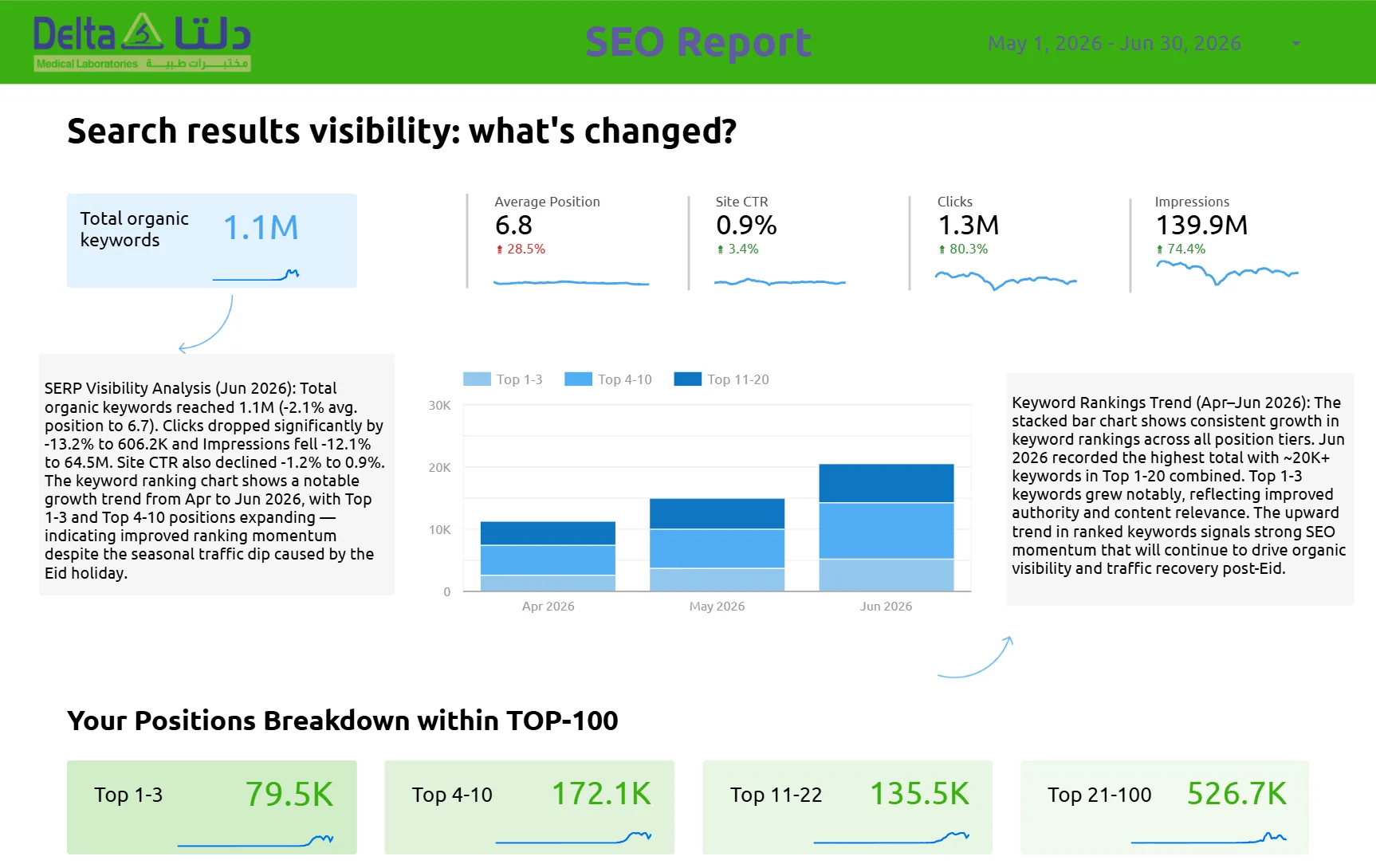
- Delta Medical Labs (Saudi Arabia), March 2026 to date: 1M+ monthly organic visits from a standing start, 159,200 ranked organic keywords, 1,186 keywords at #1 in Saudi Arabia, and 5,570 pages cited by AI engines. The July 2026 engine split is 3,600 AI Overview, 1,800 AI Mode, 130 ChatGPT, and 40 Gemini. Read the full Delta Labs case study.
- Al Hokail Medical Group (Saudi Arabia): 27,500 monthly organic visits in Saudi Arabia, 3,400 keywords ranked, 30 of them at #1, and 128 pages cited by AI engines. We do not publish a start date for this engagement, so read those as a snapshot rather than a growth rate.
- Esaal (telehealth, Arabic and English), 12 months: 220K blog clicks from Google, 19.4M search impressions at an average position of 5.5, and 753 pages cited by AI engines, the largest cited-page count on our roster after Delta.
- Ogaei Virtual Care (telehealth, Canada), August 2025 to May 2026: monthly organic clicks went from 3 to a peak of 7,931, with 28,716 clicks and 2.9M impressions in total and 40+ keywords in the Google top 10. This is the cleanest before and after on the roster.
- Ovasave (femtech, UAE), 6 months: SEO conversions up 46 percent, 53 keywords in the Google top 3, 118,700 monthly impressions, and 97 pages cited by AI engines.
Two things those numbers do not tell you. A page-level citation count is not a share of the questions patients actually ask, so 5,570 cited pages is a reach figure and nothing more. And none of these engagements ran a holdout, so the work and the growth line up in time, but we cannot claim the method isolates the cause.
| Factor | Classical Healthcare SEO (2020) | Modern AI Healthcare SEO (2026) |
|---|---|---|
| Success Metric | Page 1 Google ranking | AI citation rate + organic visibility |
| Content Priority | Keyword density & length | Accuracy, E-E-A-T, direct answers |
| Author Requirement | Optional, often anonymous | Mandatory: credentialed professional |
| Schema Priority | Basic Organization schema | Full medical entity schema stack |
| Local Optimization | Google Business Profile | GBP + Review signals + Local press |
| Measurement Tool | Google Analytics only | GSC + AI citation monitoring |
| Update Frequency | Annual or ad hoc | Quarterly minimum (AI weights recency) |
Which healthcare SEO mistakes cost you AI visibility?
The same short list of mistakes shows up in almost every healthcare audit we run, and none of them is exotic. Generic blog content with no clinical depth sits next to missing physician credentials, schema that does not describe the page it is attached to, and slow image-heavy templates that fail Core Web Vitals on a mid-range phone.
Underneath that there is usually no AEO or GEO work at all, which is what leaves your brand invisible inside ChatGPT and Gemini while your Google rankings still look healthy. Localized pages that stop at translation instead of localized intent finish the set. Each one is fixable, and fixing them compounds.
(1) Anonymous Content: Any healthcare content without a named, credentialed author gets heavily discounted in AI citations. YMYL content requires human accountability signals. (2) Outdated Statistics: Using medical statistics older than 2 years. AI systems verify claims against current medical literature, outdated data tanks your credibility score. (3) Missing Medical Schema: Generic Article schema on healthcare content misses critical signals. Physician, MedicalCondition, and MedicalProcedure schema tell AI exactly what type of content you publish and who is accountable for its accuracy.
How does AI search optimization compare to classical healthcare SEO?
Classical healthcare SEO targets the ten blue links, while AI search optimization targets the answer sitting above them and the assistant sitting beside your patient. The two are complementary rather than competing, and the healthcare brands doing best right now are the ones winning both at the same time.
To go deeper on the AI side, read the VOCTOS AI search optimization pillar guide and how to get your brand cited by ChatGPT.
What should you look for in a healthcare SEO partner?
Pick a partner who can prove AI citation growth and not only Google rankings. Ask them for ChatGPT and Perplexity visibility reports, check that they understand medical schema and physician credentialing, and ask for healthcare outcomes you can verify rather than a case study with the numbers sanded off.
If the answer to any of those is vague, you are buying activity. We publish our healthcare results with the Search Console screenshots and the live ranking reports attached.
Frequently Asked Questions
How long does healthcare SEO take to show results?
We do not promise a timeline and we will not promise a ranking. The record is all we have. Delta Medical Labs has been running since March 2026 and now carries 5,570 AI-cited pages, and Ogaei Virtual Care moved from 3 to 7,931 monthly organic clicks between August 2025 and May 2026. Both took months rather than weeks, and neither ran a holdout, so read them as what happened on those accounts and not as a forecast for yours.
Is AI search optimization safe for regulated healthcare brands?
Yes, when content is reviewed by qualified medical professionals and aligned with regulator standards. VOCTOS works inside the compliance frameworks of Saudi Arabia, Egypt, UAE, and the wider GCC.
Can VOCTOS help small clinics or only large hospitals?
Both. The seven pillar framework scales from single clinics to multi-brand hospital groups. We start every engagement with a free audit so the roadmap matches the size of the brand and the market.
Which AI engines does VOCTOS optimize healthcare brands for?
ChatGPT, Google AI Overviews, Gemini, and Perplexity are the four primary engines. We monitor citation share inside each and adjust strategy accordingly.
Does VOCTOS handle Arabic and English healthcare content?
Yes. Our healthcare content team produces both Arabic and English clinical content optimized for the Saudi Arabian, Egyptian, and Gulf markets, with localized intent rather than translated content.
Ready to Become the AI-Cited Healthcare Brand in Your Market?
If your laboratory, clinic, or hospital is invisible inside ChatGPT, Gemini, or Google AI Overviews, you are losing patients to competitors who optimized first. VOCTOS is the partner behind real, verifiable healthcare AI search results in Saudi Arabia, Egypt, and the Gulf. Explore our healthcare SEO and AEO services or request your free AI visibility audit.
Everything else we have run on Industry SEO
Written by whoever ran the work, not a content team
7 articles