We Audited 30+ AI Visibility Tools, Then Built What Was Missing
Published 9 August 2026 · Written by the team that reviewed this market before building an alternative
We reviewed more than thirty AI visibility tools before building our own client platform. The measurement in most of them is fine. The problem is that every one of them stops at the number. None of them ships the work that changes the number: no task queue, no content approvals, no roadmap, no paid media, no billing. That gap is why this article exists, and it is why we ended up building the VOCTOS Client Portal rather than adding another subscription to the stack.
This is not a tool review and we are not going to rank anyone here. If you want the names, the verified prices and which products actually support Arabic, our sister site published that separately: Best AEO tools in 2026. What follows instead is what we learned while looking. It covers the three incompatible ways this market measures the same thing, and the five things none of these products do. It also covers what a client actually needs on the other side of the number.
What we were actually looking for
Two things pushed this. First, buyer behaviour moved. SparkToro and Similarweb put 68% of US Google searches ending without a click in the first four months of 2026. G2 found in March 2026 that 51% of B2B software buyers now start research with an AI chatbot more often than with Google, up from 29% eleven months earlier.
A third of them bought from a vendor they had never heard of before the chatbot named it. Second, our clients started asking a question our reporting could not answer: what does ChatGPT say about us, and what are you doing about it. Rankings and sessions do not describe an answer.
Second, our clients started asking a question our reporting could not answer: what does ChatGPT say about us, and what are you doing about it. Rankings and sessions do not describe an answer.
So the brief was narrow. We wanted something that could tell a client which prompt moved, on which engine, and which source stopped carrying them. We also wanted it to show what work was queued to fix it, without anyone having to ask. Measurement turned out to be the easy half.
Three ways to measure the same thing, and why they disagree
This is the part nobody explains on a product page, and it matters more than any feature list. There are three approaches in this market, and they will not give you the same number for the same brand on the same day.
1. Browser automation
Ask the engine your question the way a person would and read what comes back. It measures what a user actually sees, which is the right target, and it is sensitive to session state, geography and the engine redesigning its interface.
2. Official APIs
Query the model through its API. Stable and cheap to run, and wrong in a specific way: API responses routinely diverge from what the same model returns in its consumer product, because the product layer adds retrieval, memory and ranking that the API does not.
3. Clickstream and panels
Instead of asking the engine, observe what real users were shown. Arguably the closest thing to ground truth, with a severe trade-off for a client programme: you cannot run your own prompts. You get the questions a panel happened to ask, not the questions your buyers ask.
Where the category ends
Put the two columns next to each other and the shape of the problem is obvious. The left column is a product category: something that measures prompt-level visibility and reports it back. The right column is a job: turning what gets measured into an assigned fix and an answer someone actually checked. The table below lines them up.
Based on capabilities advertised on vendor product pages, reviewed August 2026. Where a product does not advertise a capability we have read that as not covered rather than as absent.
The five things none of them do
Across every product we looked at, the same five holes appeared. They are not bugs. They are the edge of the category, and they are all reasonable places for a software company to stop. Delivery, paid media, white-label, coverage tiers and billing all sit past that edge, and the list below names each gap on its own line.
- No delivery layer. No task queue, no roadmap, no content approvals. The number lives in one system and the work lives in a spreadsheet, a chat thread and somebody’s inbox.
- No paid media. Not one of them manages Google Ads or Meta. A brand running search ads alongside an AI search programme reads two unrelated systems and does the arithmetic itself.
- White-label is not a client portal. Where it exists it is usually a re-skinned dashboard export, and it is normally reserved for higher tiers.
- Coverage is metered. Entry tiers frequently cover a single engine or a small prompt set, and the rest arrives as separate line items.
- No commercial layer. No invoicing, no retainer view, no cost of a conversion that includes the agency fee. The client never sees what the work costs next to what it produced.
Fill each hole with a separate product and you end up with four subscriptions, four logins and four versions of the truth. The client becomes the integration layer between them. That is the arrangement we did not want to sell.
So we built the missing half
The VOCTOS Client Portal exists because the measurement and the delivery had to be one click apart. It comes with an engagement, it is not licensed on its own, and here is what it actually does. The sections below walk through the scoring, the per-engine breakdown and the delivery layer underneath both.
One score, eight signals, four engines reported separately
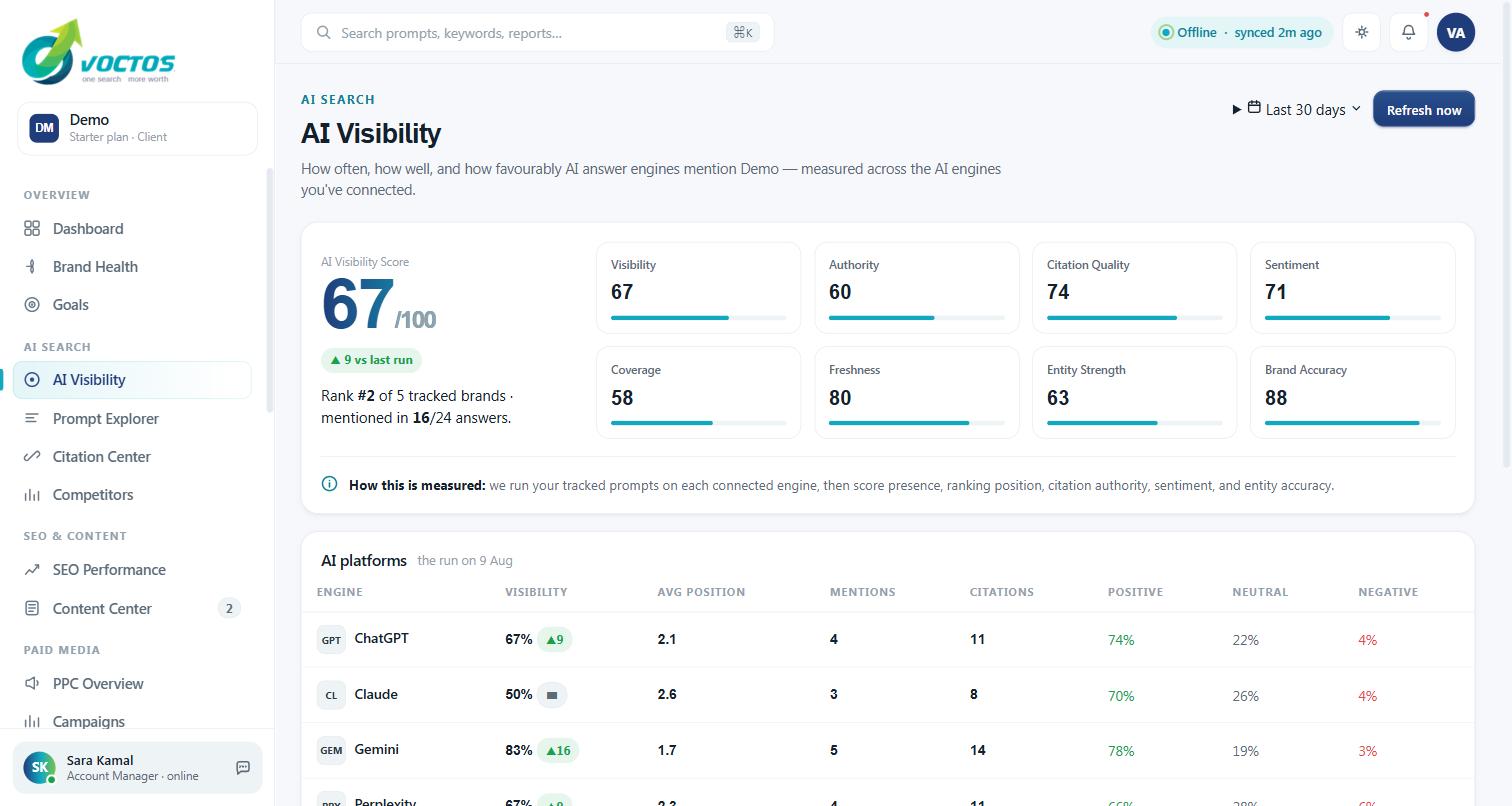
A single blended visibility percentage tells you something moved. It does not tell you who fixes it. The score splits into eight signals, and each one points at a different workstream. Coverage is a content problem, entity strength is a schema and directories problem, and brand accuracy is a source-correction problem. Underneath, ChatGPT, Claude, Gemini and Perplexity each get their own row, because on any given day they disagree enough that an average hides the only interesting thing on the screen.
Citations tracked as states, not as a list
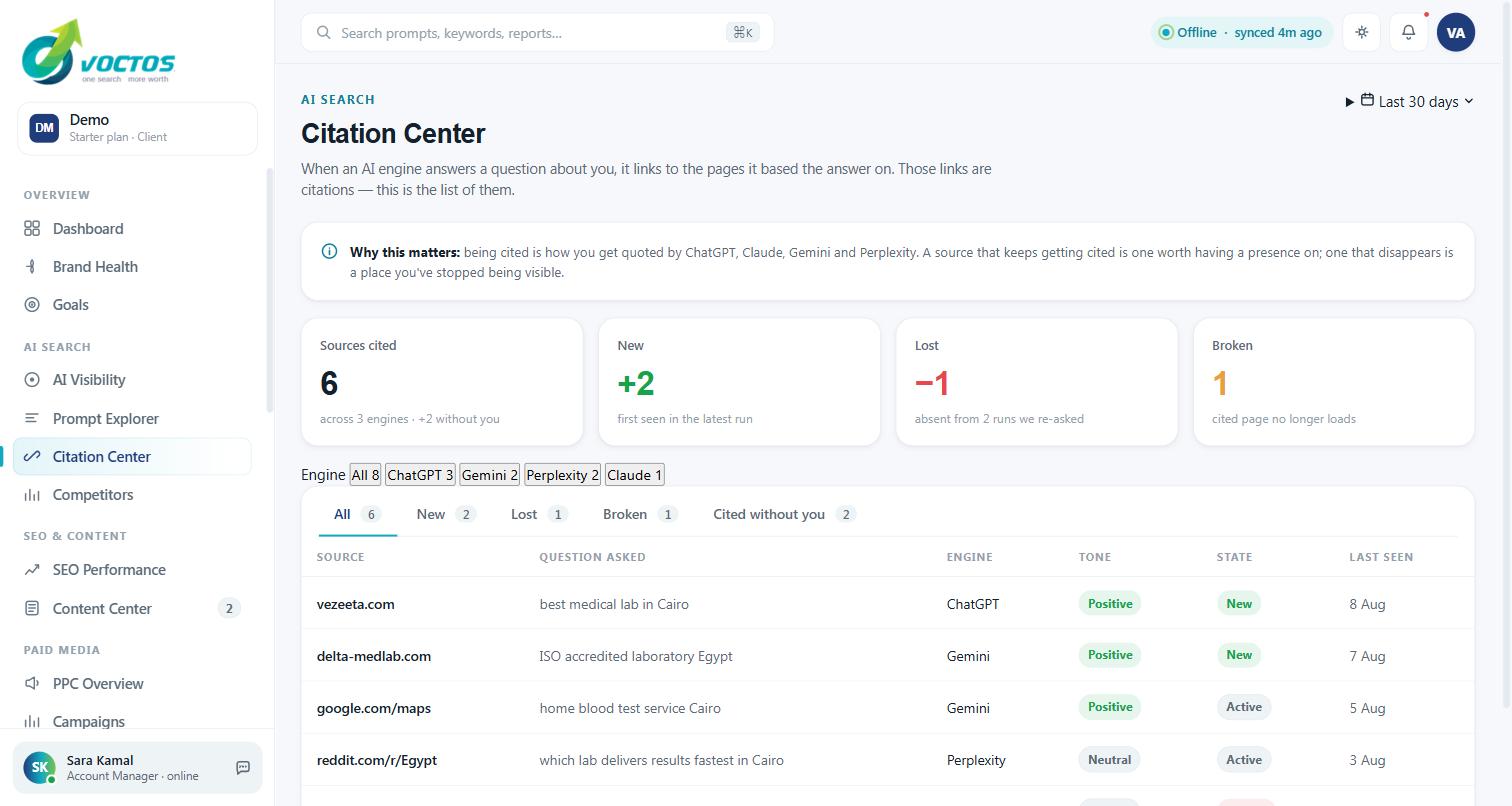
Most reporting shows the sources cited today. We track four states, because the states are where the work is. New is a source that just started carrying you. Lost is the earliest warning available, because a source drops you before the score falls. Broken means an engine is sending people to a dead URL with your name on it. And cited without you is a ranked list of sources the engine already trusts for your category and did not name you in, which beats any domain authority score as an outreach list.
And the question no tracker asks: is the answer even true?
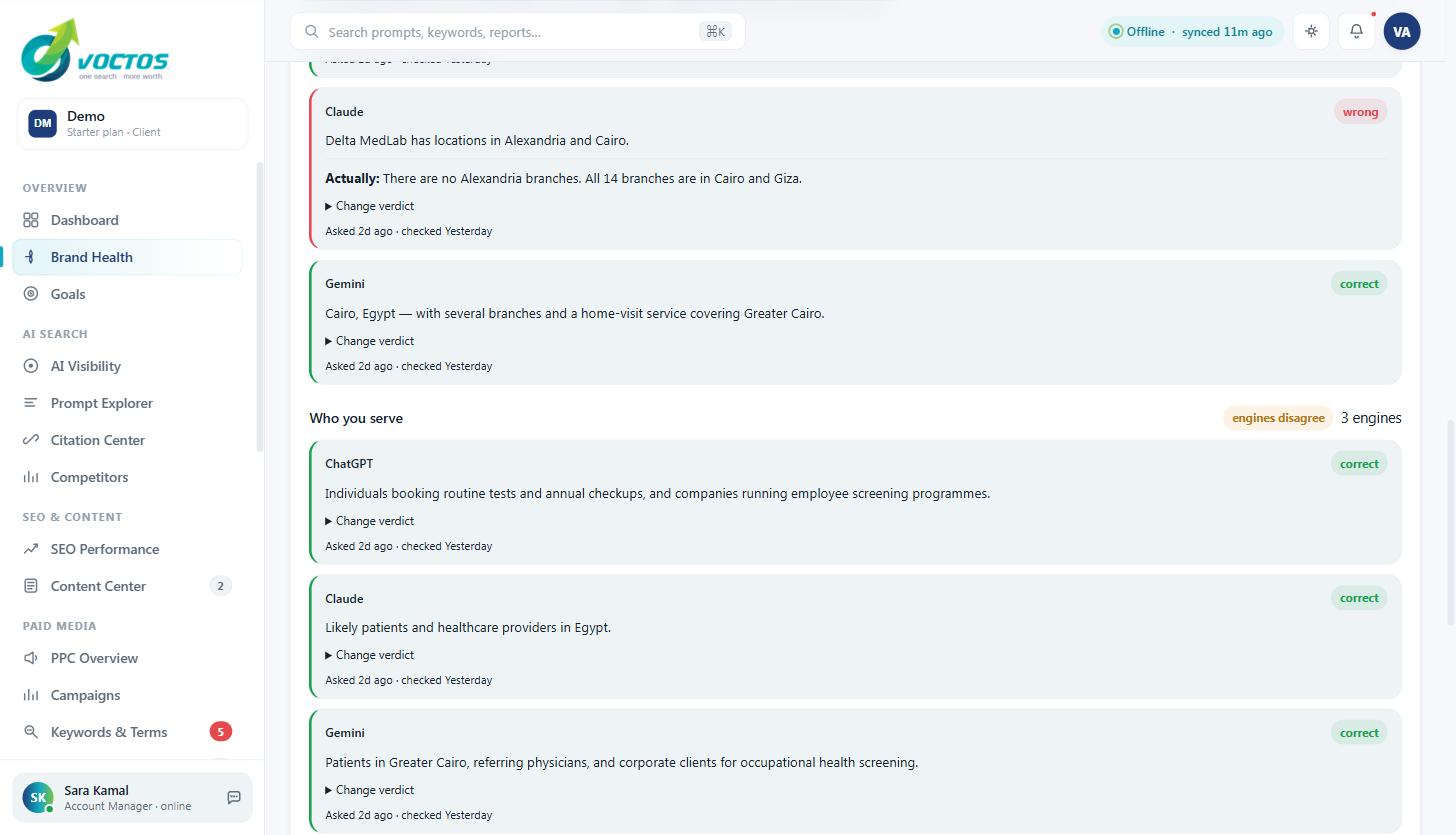
You can rank well, be described warmly, and still have an engine repeating a false sentence about you to everyone who asks. Once a month the portal puts five direct questions to each engine, stores the answers verbatim, and a person marks each one correct or wrong and writes the correction underneath. In the run below, one engine claimed a client had branches in a city they have never operated in. That is not a ranking problem or a sentiment problem, and no visibility chart would have surfaced it.
Then the half no tool ships
Behind the same login sit the roadmap and the task board, with a named owner on every card. Content approvals carry an SEO score and an AI citability score on the same row, and Google Ads and Meta come with waste analysis and budget pacing. The goals the engagement was signed for and the invoices sit there too. The paid media page prints two numbers side by side: the media-only cost per conversion, and the all-in cost per conversion that adds our own management fee. The second number makes our reporting look worse and the client’s decision better, which is the entire point.
Seven questions worth asking before you trust any AI visibility number
Whether the number comes from a product you bought or an agency you hired, the same seven questions separate a reading you can act on from a chart you have to believe. None of them requires the vendor’s cooperation to answer, and asking is free. The list below runs from method to accountability, in the order we would ask it.
- Which method produced this: browser automation, an official API, or a clickstream panel? How often does it sample?
- Are these my prompts, or the ones a panel happened to ask?
- Which engines are covered, and is every engine reported on its own row or blended into one figure?
- Is the answer text stored, or only the score? Can I read how an engine described me six months ago?
- Am I told when a source stops citing me, or only shown the sources citing me today?
- When a data source fails to sync, does the chart show a flat line or say the connection broke?
- Once I have the number, where does the work happen, and who is named against it?
Generative engines are non-deterministic. The same prompt returns different answers on different runs, and no dashboard removes that, ours included. What a dashboard can do is sample repeatedly, report each engine separately rather than blended, and attach a confidence figure to every reading. Anyone who does not raise this in a demo is either not measuring carefully or not telling you.
Frequently asked questions
What is an AI visibility tool?
It is software that measures how often and how favourably AI answer engines such as ChatGPT, Claude, Gemini and Perplexity mention a brand, and which sources those answers were built from. The category is measurement only. Acting on what it finds is a separate job that these products leave to you.
Why do two AI visibility tools give different scores for the same brand?
Because they measure in three incompatible ways. Browser automation asks the engine the way a person would, official APIs query the model directly and return answers that diverge from the consumer product, and clickstream tools observe what real users were shown rather than asking anything. Add the non-determinism of generative engines and two careful products can report different numbers on the same day.
Do any AI visibility tools manage paid media?
No. Across more than thirty products reviewed in August 2026, none manages Google Ads or Meta. AI visibility measurement and paid media management are separate categories, which is why a brand running both usually reads two unrelated systems.
How should I evaluate an AI visibility tool?
Ask which of the three measurement methods it uses and how often it samples, whether you can run your own prompts, whether each engine is reported separately, whether the answer text is stored rather than only the score, whether you are told when a source stops citing you, and what happens to the number once you have it.
Can I buy the VOCTOS Client Portal?
No. It is not licensed separately, it has no price list, and it is not sold as software. It is the platform VOCTOS clients log into as part of an engagement.
See your own numbers first
The fastest way to judge any of this is on your own domain. Send us your URL and we will run a first AI visibility read across ChatGPT, Claude, Gemini and Perplexity, show you which sources are being cited about your category, and walk you through the portal on a call.
Related reading
The VOCTOS method: Prompt-Gap Analysis and the four pillars of AI visibility. What we do with the measurement once the gaps are known, and what the method does not do.
AI Visibility Score: what it measures and how to read yours. The 45 checks behind our own scoring tool, how the four signal groups are weighted, and what the number cannot tell you.
- AEO and GEO in 2026: the complete AI search optimization playbook
- How to get your brand cited by ChatGPT
- How to optimize for Google AI Overviews
- GEO for Arabic content
- Inside the VOCTOS Client Portal, screen by screen
Written by the VOCTOS team, August 2026. Screenshots are live views of the VOCTOS portal taken from a demo workspace; the figures inside them are demo data.
Everything else we have run on GEO & AEO
Written by whoever ran the work, not a content team
26 articles
Read also
All GEO & AEOChatGPT Is a Top-7 Website in Three Arab Markets: Similarweb and StatCounter Data for September 2026
What Google AI Mode Links to in Arabic: 28 Prompts and a Country Effect Arab Sites Should Test
GPT-6 Is Now the Default in ChatGPT: What Changed in Shopping Answers for Gulf and Egyptian Buyers (Before/After Test)

llms.txt on Arab Websites: Who Publishes One, What It Contains and Whether AI Assistants Use It