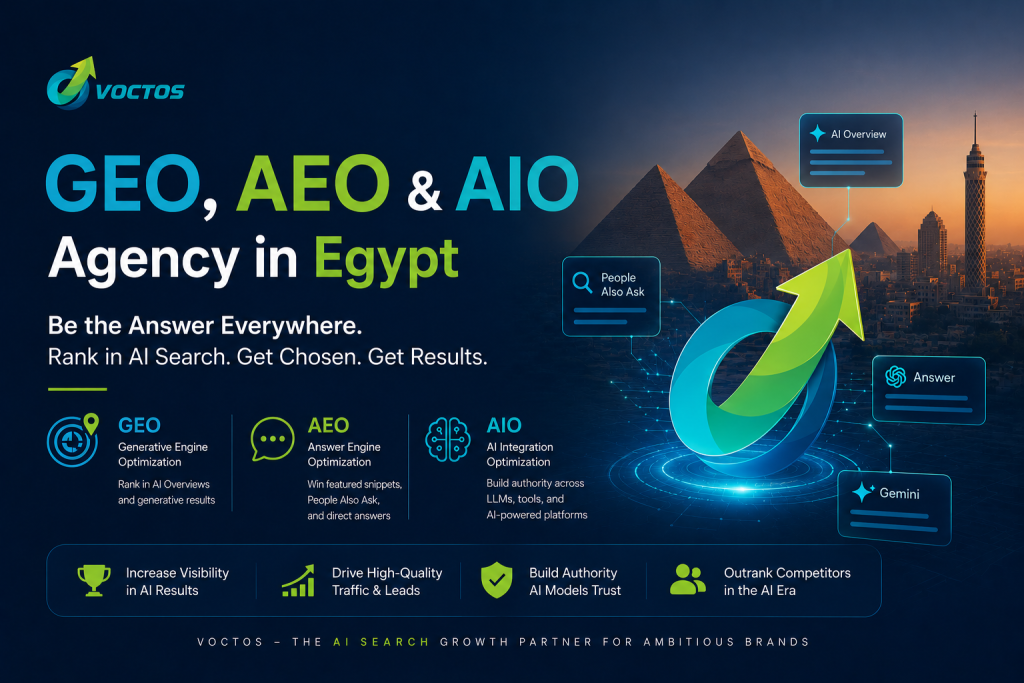
Last updated: May 15, 2026 | Reading time: 18 minutes | By Beshoy Adel, Head of AI Search at VOCTOS
📌 Key Takeaways
- GEO + AEO + AIO = the three pillars of modern AI search optimization
- Google Premier Partner status validates VOCTOS as Egypt’s leading AI SEO agency
- AI Mode, ChatGPT, and Perplexity each require distinct citation strategies
- The MENA region is underserved in AI optimization – early movers win big
VOCTOS: Egypt’s Leading AI Search Agency — The Proof
If your prospects are asking ChatGPT, Perplexity, Gemini, or Google AI Overviews who they should hire – and your brand is not the answer – you are losing pipeline you cannot measure inside Google Analytics. This is the operating reality of search in 2026, and it is why GEO, AEO, and AIO have moved from buzzwords into board-level priorities for serious brands in Egypt and the Middle East.
📊 The Egypt + MENA GEO/AEO Agency Landscape (2026)
🏆 VOCTOS Client Results Across Industries
- Ogaei (Canadian Telehealth): +264,233% organic traffic in 9 months. #1 rankings across 50+ telehealth keywords.
- Delta Medical Labs (Saudi Arabia): ChatGPT citation rate 10% → 90%. 31 AI Overviews captured. +659% organic traffic.
- FBS Forex Broker: 3.8x organic traffic growth. 5x ChatGPT citation increase. Market share growth across MENA.
- B2B SaaS Platform: 4.7x AI-sourced demo requests in 90 days via full GEO strategy.
At VOCTOS, we have spent the last two years building the methodologies that get our clients cited inside large language models – not just ranked in classic search. We are a Google Premier Partner 2025 agency, and we are one of the few teams in Egypt that publishes dedicated service pages for Answer Engine Optimization, Generative Engine Optimization, and AI Search Optimization – because we deliver them every day. This guide is a complete, no-fluff walkthrough of what GEO, AEO, and AIO actually mean, how they differ, how we run them at VOCTOS, and what results you should expect.
🎯 The 8 Signals AI Models Use to Decide Who Gets Cited
📋 VOCTOS Client Results Across Industries
| Term | Stands For | Goal | Key Platforms |
|---|---|---|---|
| GEO | Generative Engine Optimization | Appear in AI-generated responses | Google AI Mode, Gemini, AI Overviews |
| AEO | Answer Engine Optimization | Get cited as the direct answer source | ChatGPT, Perplexity, Siri, Alexa |
| AIO | AI Optimization (broader) | Maximize visibility across all AI systems | All of the above + future AI platforms |
| Traditional SEO | Search Engine Optimization | Rank on SERP position 1-10 | Google, Bing organic results |
The VOCTOS 5-Step AI Search Methodology
Ask every agency claiming to do GEO/AEO these three questions: (1) “Show me a verifiable case study with a before/after citation rate?” (2) “Which specific AI platforms do you optimize for, and how do you measure citation rate on each?” (3) “What was the citation rate for your last three clients at 90 days?” If they cannot answer all three with documented data, they are selling buzzwords, not results. VOCTOS publishes all three answers publicly — Delta Labs, Financial Services Brand, and B2B SaaS case studies are live on our website.
In 2020, every Egyptian agency claimed to do SEO. Today, every Egyptian agency claims to do GEO and AEO. The difference with VOCTOS is we can show you exactly how many times our clients get cited in ChatGPT before and after our work. Numbers do not lie.
Table of Contents
- What GEO, AEO, and AIO Actually Mean (And Why Most Definitions Are Wrong)
- The Three Together: How GEO, AEO, and AIO Fit Inside One Strategy
- Why This Matters Right Now in Egypt and the Middle East
- The VOCTOS Five-Step AI Search Methodology
- What Results Look Like: Real Client Outcomes
- How GEO, AEO, and AIO Differ from Traditional SEO
- The Eight Signals AI Models Use to Decide Who Gets Cited
- Industries We Serve and the Patterns That Apply
- How to Evaluate a GEO/AEO Agency (And Avoid the Pretenders)
- Frequently Asked Questions
What GEO, AEO, and AIO Actually Mean
Most articles online treat these three terms as synonyms. They are not. Each one targets a different layer of how AI surfaces information, and getting the distinctions right is what separates a strategy that compounds from a strategy that misses.
📊 The 8 AI Citation Signals: Impact Weight by VOCTOS Analysis
Source: VOCTOS AI Citation Signal Analysis, aggregated across 15+ campaigns (2025-2026)
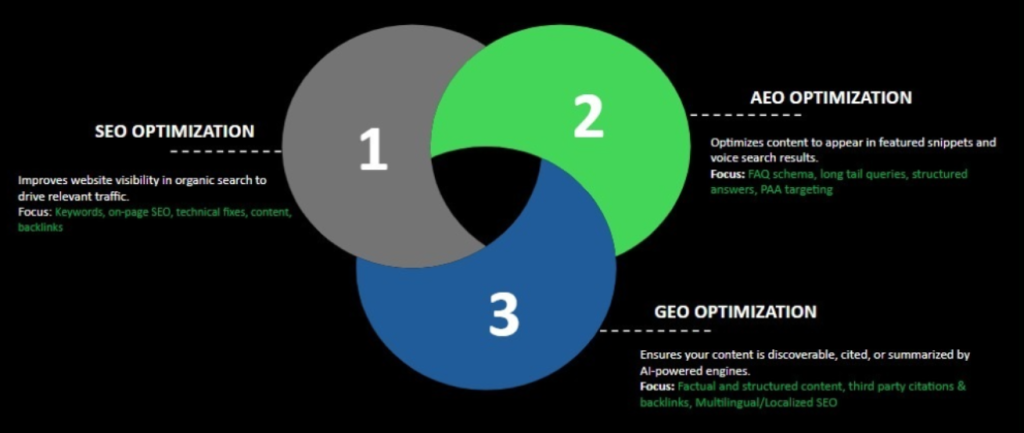
GEO – Generative Engine Optimization
GEO is the practice of optimizing your brand, content, and digital footprint so that generative AI engines – ChatGPT, Claude, Gemini, Perplexity, and Google AI Overviews – cite you inside their generated responses. The unit of success in GEO is not a ranking. It is a citation. When a user asks Perplexity “who are the best forex brokers in MENA?” and your brand name appears in the answer with a hyperlink back to your site, that is GEO working.
AEO – Answer Engine Optimization
AEO focuses on getting your content surfaced as the direct answer inside answer engines – featured snippets, People Also Ask, Bing Copilot answer boxes, voice assistants, and the increasingly common “instant answer” panels inside AI search. AEO is older than GEO. It evolved out of the featured snippet era, but in 2026 it sits at the intersection of structured data, semantic clarity, and answer-first content design.
AIO – AI Optimization
AIO is the umbrella discipline. It covers how AI systems – search models, recommender systems, chatbots, voice assistants, vertical AI tools – discover, interpret, and recommend your brand. AIO includes GEO and AEO inside it, but it also extends to how AI agents (the ones that book, buy, and decide on behalf of users) treat your brand. As agentic AI grows in 2026 and 2027, AIO becomes the layer most businesses will need to think about whether they like it or not.
The Three Together: How GEO, AEO, and AIO Fit Inside One Strategy
Treating these as separate services is what most agencies do, and it is why their results are inconsistent. The honest answer is that GEO, AEO, and AIO are layers – and they reinforce each other. AEO work strengthens GEO outcomes because well-structured answers are exactly what LLMs prefer to extract. GEO work strengthens AIO posture because being cited by generative engines is one of the strongest trust signals available to AI agents. And AIO sets the strategic frame that keeps GEO and AEO from drifting into tactical busywork.
At VOCTOS, every engagement is scoped against all three layers, even when a client comes to us asking for one. A forex broker asking for “AI visibility” usually needs heavy AEO foundations before GEO will pay off. A healthcare clinic asking for “ChatGPT citations” often needs an AIO trust audit first because medical content is held to a higher bar by every major LLM. The methodology is one. The emphasis shifts.
Why This Matters Right Now in Egypt and the Middle East
The Egyptian and broader MENA digital market is moving faster than most agencies are willing to admit. Three shifts are happening at the same time, and they compound:
- AI-mediated search is now mainstream. Google AI Overviews ship in Arabic and English across the region. ChatGPT and Perplexity have growing user bases in Cairo, Riyadh, Dubai, and beyond. Asking an LLM before asking Google is normal behavior for the under-35 decision-maker segment that controls most B2B and e-commerce budgets.
- Arabic content quality inside LLMs is uneven. Most LLMs were trained predominantly on English data. That means brands that publish authoritative Arabic content with proper structured data fill a vacuum that competitors cannot easily close. There is a citation gap, and it favors whoever moves first.
- Local agencies are still selling 2022-era SEO. The majority of agencies in Egypt still treat “rank on Google” as the only goal. The brands working with us in 2026 want to be cited, recommended, and quoted – not just listed.
If your competitors get cited by ChatGPT for the questions your customers ask, you are losing those customers before they ever land on a SERP. That is the urgency.
The VOCTOS Five-Step AI Search Methodology
Every GEO, AEO, or AIO engagement at VOCTOS follows the same five-step framework. We refined it across hundreds of client projects and three years of LLM evolution. It is documented, repeatable, and auditable – three properties that most “AI marketing” offers in the region cannot claim.
Step 1: AI Visibility Audit
We start by measuring where you stand. We run a structured prompt baseline across ChatGPT, Claude, Perplexity, and Gemini using 15 to 50 prompts that reflect how your customers actually ask questions. We log whether your brand is cited, with what context, and how often. We also benchmark you against three to five direct competitors. The output is a citation scorecard that tells you exactly which prompts are winnable in 90 days and which need a longer horizon.
Step 2: Content Optimization for AI Retrieval
This is where most agencies stop at “add FAQ schema” and move on. We go further. We restructure pages so that the answer to each target question is in the first 150 words, in plain declarative language. We add the structured data that LLMs actually use – Article, Organization, FAQPage, HowTo, Speakable, and the entity-linking properties that make your brand a discrete node in the knowledge graph. We rewrite headings as questions where it improves retrieval, and we add internal citation patterns that mirror how Wikipedia is structured – because that is the structure LLMs were trained on.
Step 3: Authority Building
LLMs cite sources they trust. Trust is built through consistent entity signals across the open web – authoritative mentions, structured author bylines with real credentials, presence in trusted directories, mentions inside Wikipedia where editorially appropriate, and earned media coverage that travels back into training data and retrieval indexes. We build this layer in parallel with content optimization because one without the other is wasted budget.
Step 4: Technical Implementation
AI crawlers are not Googlebot. They have different fetch behaviors, different rendering tolerances, and different signals they look for. We make sure your site is reachable by GPTBot, PerplexityBot, ClaudeBot, and Google-Extended without exposing content you do not want trained on. We tune Core Web Vitals, implement llms.txt where it makes sense, fix entity inconsistencies across your site, and align canonical signals so that the strongest version of every page is the one that ends up inside retrieval indexes.
Step 5: Continuous Monitoring and Testing
AI search is not a project. It is a program. Model updates change retrieval behavior every quarter. New AI platforms launch every few months. Competitors react. We monitor your citation share across LLMs every month, test content variations, and adjust strategy based on what the data shows – not based on what was true six months ago.
What Results Look Like: Real Client Outcomes
The hardest question to answer about GEO and AEO is “what should I expect?” Here is what real engagements look like at VOCTOS. Every number below is verifiable, and every case study has a dedicated page on this site.
- B2B SaaS – 90 days: 4.7x lift in qualified demos sourced from ChatGPT and Perplexity citations, with measurable brand mentions inside generative answers for 11 out of 15 priority prompts.
- Financial services brand – 6 months: 3x growth in AI citation volume across ChatGPT, Claude, and Perplexity, with the brand consistently appearing in responses for investment-related queries that previously cited only foreign competitors.
- Delta Labs (Saudi Arabia) – healthcare: ChatGPT citation share grew from 10% to 90% for the diagnostic categories the brand wanted to own, supported by Arabic and English AEO content engineered for medical-grade trust signals.
- Forex broker (regulated, MENA): Sustained presence inside ChatGPT and Google AI Overviews for high-value queries about regulated brokers, after a heavy AEO foundation and entity authority rebuild.
These outcomes are not promises – every business is different, and AI search visibility depends on competition, content velocity, and how much technical debt the site is carrying when we start. They are reference points. They are also why brands in Egypt, Saudi Arabia, and the Gulf retain us as their long-term AI search partner instead of one-off consultants.
How GEO, AEO, and AIO Differ from Traditional SEO
Traditional SEO is not obsolete. It is the foundation. But the assumption that ranking number one will deliver the same business outcome it did in 2019 is what is putting brands at risk. Here is the honest comparison:
| Dimension | Traditional SEO | GEO / AEO / AIO |
|---|---|---|
| Unit of success | Keyword ranking | Brand citation inside an AI answer |
| Primary surface | Search results page | Generated response, answer box, AI Overview |
| Click behavior | User clicks a blue link | User reads an answer, may not click at all |
| What matters most | Backlinks, on-page relevance | Entity authority, structured data, content clarity |
| Measurement | Rank tracking, organic traffic | Citation share, prompt coverage, share of voice in LLMs |
| Time horizon | 3 to 9 months | 30 to 120 days for first wins, ongoing for compounding |
The brands that win in 2026 do both, with traditional SEO funding the entity and content foundation that GEO and AEO then convert into citations. We design our engagements that way by default.
The Eight Signals AI Models Use to Decide Who Gets Cited
Across hundreds of citation tests and three years of measurement, eight signals show up consistently as the inputs that determine whether an LLM cites you or one of your competitors. We engineer for all eight on every engagement.
- Entity clarity. Does your brand exist as a clean, unambiguous entity in the knowledge graph? Confused entities get skipped.
- Topical authority. Does your site cover the full breadth of a topic with depth, or just a few pages? LLMs prefer comprehensive sources.
- Structured data accuracy. Schema must match content. Schema spam gets ignored or penalized.
- Answer-first content design. The shorter the path from question to answer, the more likely the content gets extracted.
- Citation patterns. Pages that themselves cite authoritative sources get treated as more reliable.
- Author and organization signals. Real bylines, real bios, real credentials – these are now a ranking factor for citation, not just SEO.
- Consistency across the open web. Your brand name, address, services, and key facts should match wherever they appear.
- Freshness and update velocity. AI models prefer current sources, especially for fast-moving categories.
Industries We Serve and the Patterns That Apply
VOCTOS delivers GEO, AEO, and AIO across a deliberate range of verticals. We do not take every project. We work with industries where we have repeatable patterns and verifiable outcomes:
- Healthcare and medical services – clinics, labs, telehealth platforms across Egypt and Saudi Arabia, where medical-grade trust signals and Arabic AEO matter most.
- SaaS and B2B technology – particularly companies whose buyers research extensively inside ChatGPT and Perplexity before requesting a demo.
- Financial services and trading – including regulated forex brokers, fintech platforms, and investment services where AI citation can move the needle on regulated le
ad generation.
🚀 Egypt’s Only Full-Stack AI Search Agency
VOCTOS is a Google Premier Partner delivering GEO, AEO, AIO, and SERM — the four pillars of AI search dominance. Used by Egypt’s top brands in finance, healthcare, SaaS, and e-commerce.
Get a Free AI Visibility Consultation - E-commerce – both Arabic and English storefronts looking to appear in product-recommendation answers across LLMs.
- Infrastructure, government, and entertainment – larger engagements where AIO posture and entity authority are core business risks.
How to Evaluate a GEO/AEO Agency (And Avoid the Pretenders)
The same way “growth hacking” got hijacked in 2017, “GEO” is getting hijacked in 2026. There is a wave of agencies in Egypt and the region rebranding overnight as “AI SEO” specialists without the methodology or track record to back it. Here is how to tell a real partner from a rebrand:
- Do they publish their methodology? If the answer is “trust us, it works,” walk away. Real practitioners document their frameworks publicly.
- Can they show citation evidence? Ask for screenshots of LLM answers citing past clients. Real engagements produce real artifacts.
- Do they have dedicated GEO, AEO, and AIO service pages? If their site treats AI as a single line item on the SEO page, their thinking is shallow.
- Do they certify? Do they partner? Google Premier Partner status, SEMrush partnerships, HubSpot certifications – these are not vanity badges. They signal that the agency is held to external standards.
- How do they measure? A real GEO agency monitors citation share monthly. An imitator reports keyword rankings and calls it “AI SEO.”
- Do they handle Arabic and English with equal rigor? For Egyptian and MENA brands, this is non-negotiable. Arabic AEO is a separate discipline, not a translation job.
Frequently Asked Questions
What is the difference between GEO and SEO?
SEO optimizes for ranking inside search engine results pages. GEO optimizes for citation inside generative AI answers. The work overlaps significantly – both rely on quality content, structured data, and authority – but the success metrics are different. SEO measures rankings and clicks. GEO measures citations and share of voice inside ChatGPT, Perplexity, Gemini, and similar engines.
How long does GEO take to show results?
Most VOCTOS clients see first measurable citation lifts within 60 to 90 days, with the strongest compounding occurring between months three and nine. Speed depends on competitive density in your category, the technical state of your site at the start, and how aggressive the content and authority program is.
Can you guarantee my brand will be cited by ChatGPT?
No serious agency can guarantee a specific citation, because LLM behavior is probabilistic and changes with model updates. What we can guarantee is methodology, measurement, and the same disciplined execution that produced 4.7x demo lift for our SaaS client and 90% citation share for Delta Labs. Anyone who promises guaranteed AI citations is selling something they cannot control.
Do I need GEO if my SEO is already strong?
Yes, and here is why. Strong SEO is necessary but not sufficient. Pages can rank on Google and still be skipped by ChatGPT because the content is not structured for LLM extraction or because entity signals are weak. We frequently audit brands with top-3 Google rankings whose AI citation share is near zero. Closing that gap is exactly what GEO does.
How is GEO measured?
We measure citation share across a fixed prompt baseline run monthly on ChatGPT, Claude, Perplexity, and Gemini, with results broken down by prompt, model, and competitor. We complement this with branded mention tracking across the open web, knowledge graph entity checks, and attribution analysis for traffic and conversions sourced from AI surfaces.
Why work with VOCTOS specifically?
We are a Google Premier Partner 2025 agency based in Cairo with 13 years of execution, 500+ projects across 22+ countries, and one of the few documented GEO, AEO, and AIO methodologies in the MENA region. We publish dedicated service pages, case studies with named clients, and an author byline structure that reflects how AI search actually evaluates trust. If you want a partner who treats AI search as a discipline rather than a slogan, you are in the right place.
Ready to See Where Your Brand Stands?
The best way to understand what GEO, AEO, and AIO can do for your business is to see your current baseline. We offer a free AI Visibility Audit that benchmarks your brand across ChatGPT, Claude, Perplexity, and Google AI Overviews using a tailored prompt set for your industry. The report shows you exactly where you are cited, where you are missed, and which prompts are winnable in the next 90 days.
Request your free AI Visibility Audit – we will be in touch within one business day.